Tarot as Self-Knowledge, Not Fortune-Telling
Solaris Tarot · 15 April 2026 · 5 min
Tarot as self-knowledge sounds, at first, like a contradiction. The cultural image of Tarot is something else entirely: someone at a table with a spread announcing what is about to happen. That image sets the terms of the conversation in advance — you either believe in the prediction, or you dismiss it whole.
But there is a third way of looking at it. The question is no longer whether the cards "get it right" or "get it wrong," but what you can see about yourself when you sit down with them, with time and honesty.
At Solaris Tarot, we believe this framing respects the skeptical reader and the reader who arrives with a spiritual sensibility in equal measure. Neither has to give ground. The cards can be a useful mirror without anyone signing up for a worldview they don't share.
What Tarot does not do
Let's start with what we are not going to promise you.
Tarot does not predict the future in a deterministic way. It does not tell you "you'll get a call on Tuesday" or "that person will come back in three months." The future is not written into a deck of 78 cards, and anyone who assures you otherwise is overstating what a spread can offer.
It does not take your agency either. A reading does not decide for you: it does not choose your job, end your relationship, or sign your contracts. Whatever you do next is still yours — with your consequences and your responsibility.
And something important: Tarot is not a substitute for professional support. If you're going through an emotional crisis, a medical concern, or a complex legal or financial decision, you need the specialist who handles that. We are a tool for reflection, not a clinical consultation.
Saying this plainly doesn't diminish Tarot. Quite the opposite: only once you know what Tarot is not, can you begin to use what it actually is.
What it does: offer a symbolic framework
The 78 cards of the Tarot are, first of all, a catalog of human situations. Love, loss, hard decisions, transitions, fears, desires, moments of calm. Very few experiences fall outside that repertoire.
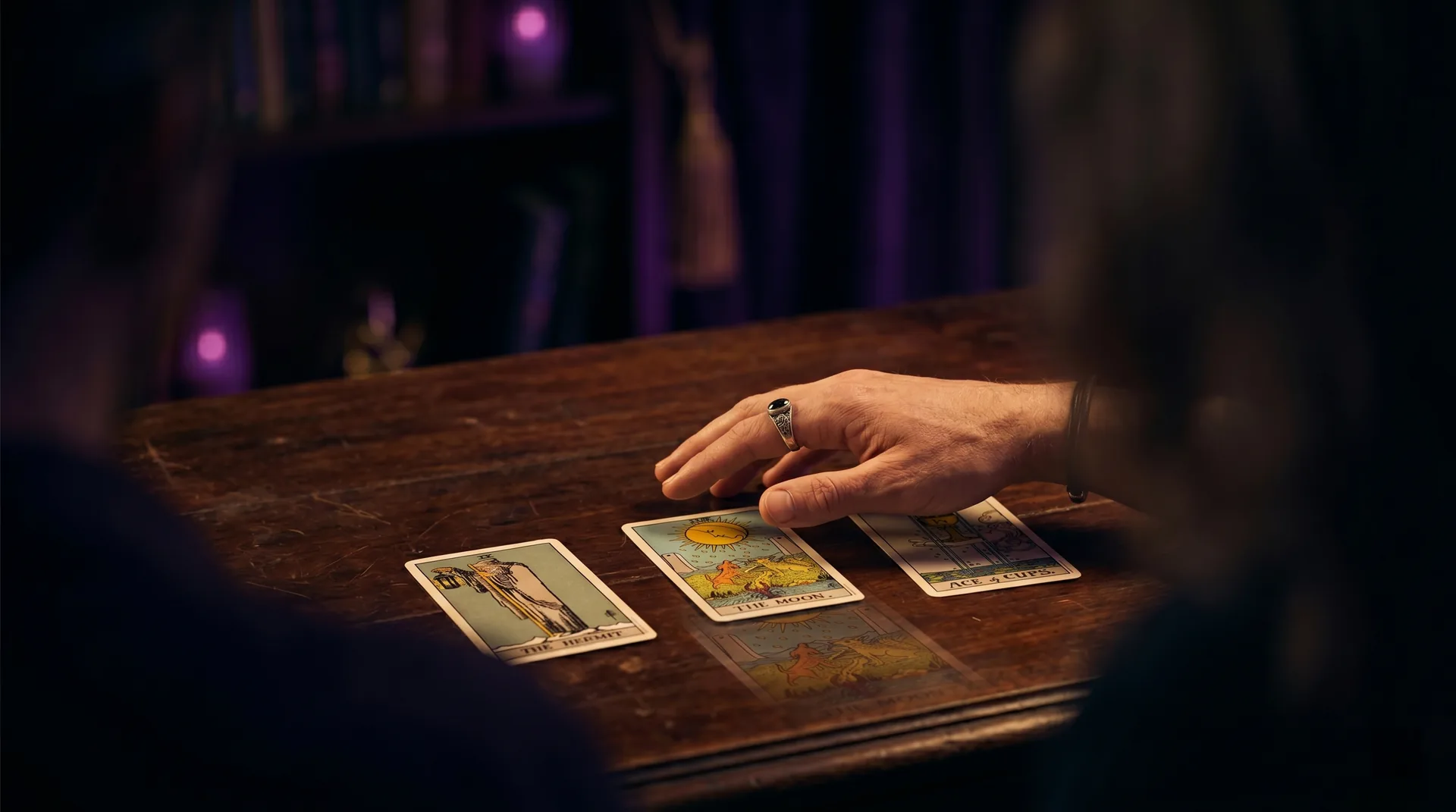
When you draw a card, your mind does something very specific: it projects. The image of The Hermit arrives as lantern, staff, and solitary path, and you fill it with your own material. For one person it becomes "I need to step back for a while"; for another, "I'm lonely and hadn't named it yet." The card doesn't change. What changes is what you see in it.
That mechanism of projection is precisely what makes it valuable. What you think you see in a card says a great deal about you: what worries you, what moves you, which part of your story is asking for space. The symbol works as an honest pretext for putting into words what you already sensed.
The Moon, for instance, doesn't "mean" anxiety or confusion in any fixed way. In today's spread, it means whatever your mind chooses to associate with that mist between two towers. If it resonates as fear, there's something there to look at. If it resonates as intuition you can't quite translate yet, that's something else to explore.
In this key, Tarot doesn't give you answers. It gives you better-framed questions.
Why it works even if you don't believe in the mystical
A reading helps even without invoking anything supernatural, and that doesn't make it any less real or less useful.
What happens has simple names. Pattern recognition: on seeing an archetypal image, your brain connects it with your own situation. Projection: you attribute meanings to the card that were already in you, and naming them stops them from being diffuse. Metacognition: you force yourself to think about what you think, to look at your decisions from the outside. Narrative: you arrange into a small story what used to be just emotional noise.
None of this contradicts a more spiritual reading. Anyone who senses something more — a meaningful coincidence, a synchronicity, an inner guidance — finds room here too. The subjective experience of meaning doesn't compete with the psychological explanation; it sits alongside it.
That's why we prefer not to "debunk" Tarot as if it were a trick, nor sell it as if it were magic. Both postures oversimplify something that, in practice, is rather more honest: a structured conversation with yourself.
How to use it honestly
If you approach Tarot with this mindset, a few small habits make a real difference.
Ask real questions. "What do I need to see about this situation?" works far better than "will things go well for me?" Open questions open things up; closed questions close in on themselves.
Take notes. Write down the question, the cards, what you thought when you saw them. Not to hunt for hits, but to notice patterns: which themes keep coming back, which cards show up at similar moments, how your way of interpreting yourself evolves over time.
Pay attention to repetitions. If the same card keeps you company for weeks, it's probably neither statistical coincidence nor a message from the universe — it's that your mind has been circling that topic for a while, and the card still strikes you as relevant.
Give the reading time. A reading isn't exhausted in the five minutes of the session. Come back to it the next day, a week later, when the decision gets closer. Often the value shows up there, when life catches up with what you had written down.
And keep your own judgment. If an interpretation doesn't fit, you can set it aside. Tarot is a tool at your service, not an authority you answer to.
An invitation
We invite you to try Tarot exactly like this: as a reflective practice, without grandiose promises and without having to give up your way of seeing the world.
You don't need to decide in advance whether you "believe" in something larger. All it takes is curiosity, a quiet moment, and a genuine willingness to listen to yourself. The rest — the cards, the questions, the words you find to name yourself — you discover along the way.
Tarot on Solaris Tarot is a tool for reflection and entertainment. It does not substitute for professional medical, legal, financial, or psychological advice.
Curious to explore? Start your first reading on Solaris Tarot →
Ready for your first reading?
Get started